(06) — Case study
Year End Forms — filed in minutes, not weekends.
Empowering QuickBooks Online customers and their accountants to prepare and file contractor tax forms — saving 64% of the time they used to lose to year end so they can get back to what matters.
Client
QuickBooks Online
Role
Lead Designer
Year
2020 — 2021
Team
PM, Eng, Research, Tax
High Fi Deliverables
MVP and V1, shipped across two seasons.
The shipped flow
One screen, one decision at a time.
We collapsed the year-end ritual into a five-step wizard. Each step asks for one thing, confirms what we already know, and lets the customer hand off to their accountant at any point.
Outcome
64%
less time spent prepping contractor forms during year end
2
tax regimes shipped — 1099-NEC in US and T4A / T5018 in CA
V1 → MVP
shipped across two consecutive year-end seasons
Context
Year end is a six-week sprint nobody wants to run.
Every January, small business owners and their accountants scramble to reconcile a year of contractor payments and file the right forms before the IRS and CRA deadlines.
Inside QuickBooks Online, the data was already there — but the path to a filed form wasn’t. Customers stitched together spreadsheets, mailers, and third-party services just to get one contractor across the finish line.
“I’d rather do anything else than touch year end.”— bookkeeper, research session 04
Exploration
Cheap, fast, and on paper first.
Before pixels, we sketched dozens of flow variants — wizard vs. table, single contractor vs. batch, in-product vs. partner handoff. Cheap prototypes let us kill weak ideas in hours instead of sprints.
Process
Six moves, from blank canvas to filed form.
- 01
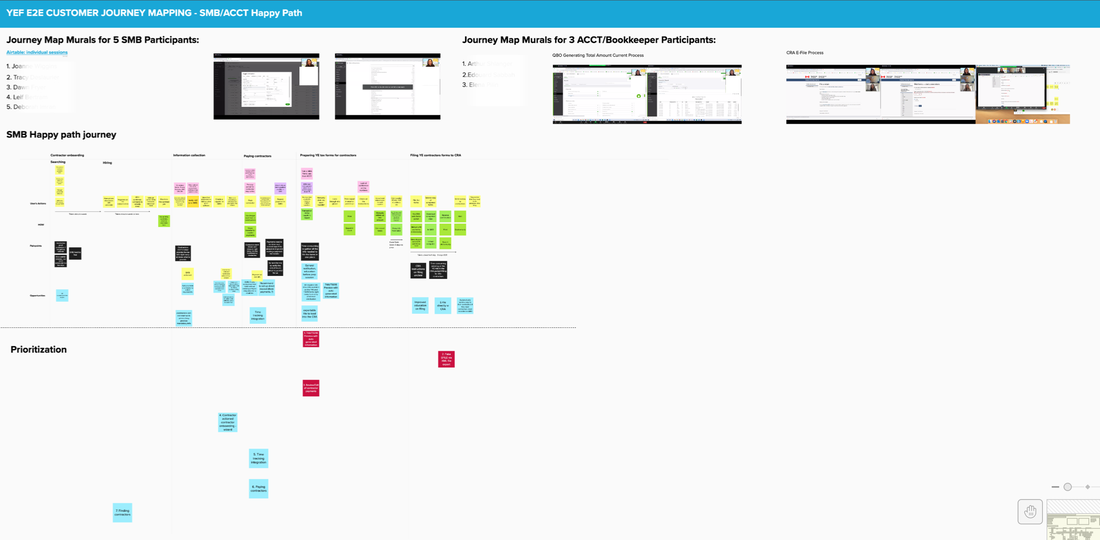
Customer journey mapping
End-to-end mapping with SMBs and accountants to surface friction during year end — from tracking eligible payments to e-filing.
- 02
Cross-geo product research
Studied competitor flows across US and CA tax regimes (1099, T4A, T5018) to align mental models with regulatory edges.
- 03
Synthesis & prioritization
Distilled themes into a contractor persona, storyboard, and an ideal-state narrative to align the squad on what to ship first.
- 04
Sketches & rapid prototyping
Low-fi paper sketches into clickable Axure / Sketch prototypes — exploring wizard, list, and review patterns side by side.
- 05
Usability testing
Moderated sessions with bookkeepers and accountants — measuring task completion, confidence, and trust in the numbers.
- 06
Co-creation workshop
Brought partners into the canvas to co-design the contractor setup and review steps — collapsing weeks of debate.
Reflection
The thing I keep coming back to with Year End Forms — the win wasn’t a clever interaction. It was treating the deadline itself as the brief. Every decision we made earned its place by giving the customer back an hour they didn’t have.
The MVP shipped a year after V1, deeper, broader, and quieter. The best compliment we got from research: “Oh. That’s it?”